
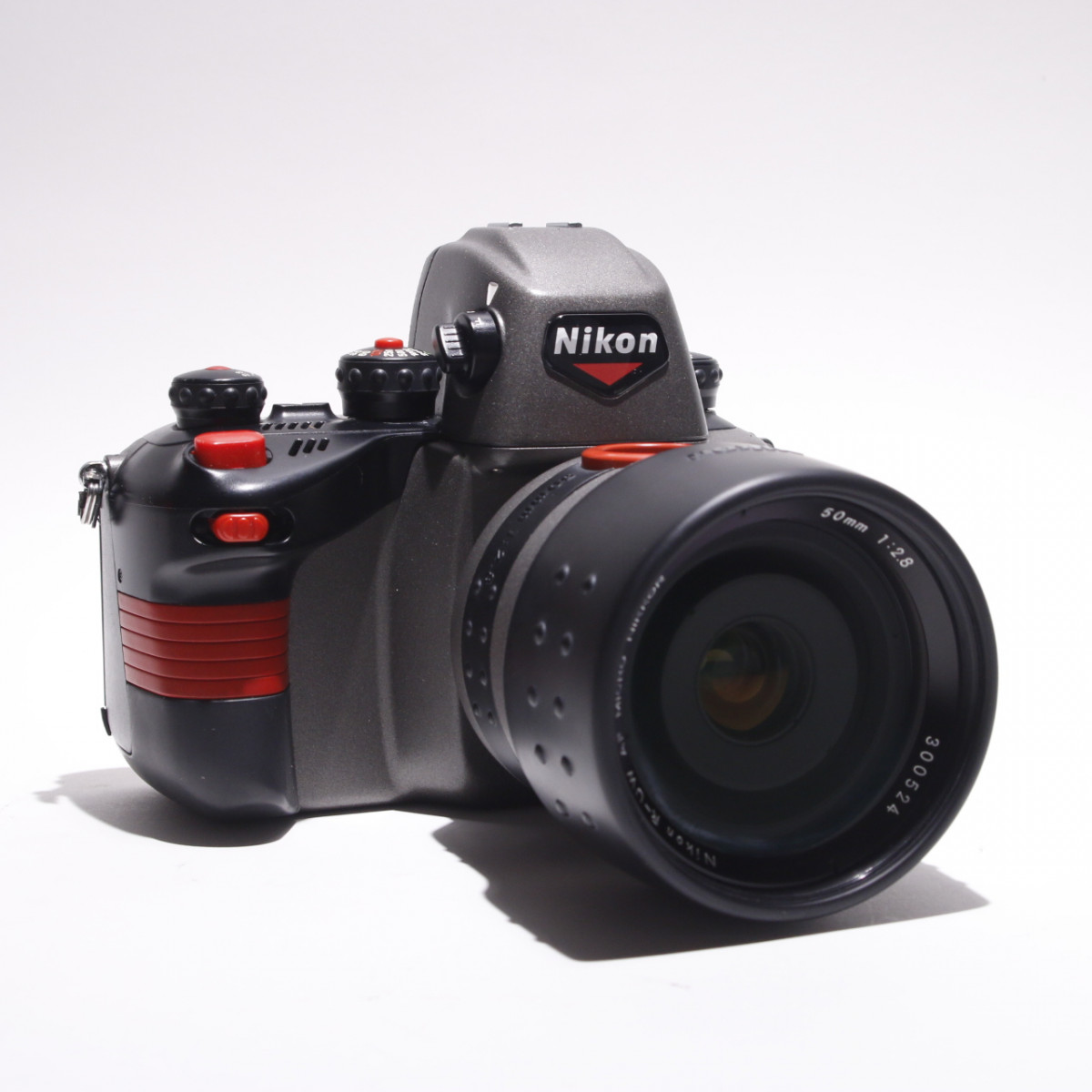
Nikon Cameras Nikonos RS
1992
The Nikonos RS, introduced in 1992, was the world's first underwater autofocus single-lens reflex (SLR) camera, representing a revolutionary, albeit short-lived, departure from the non-SLR, manual focus designs of its predecessors.
Key Features and Specifications
Design and Function: Unlike previous models, the RS was a true SLR camera, allowing photographers to view and focus through the lens with a bright high-eyepoint action finder, making composition more accurate, especially when wearing a dive mask.
Autofocus System: It featured a sophisticated TTL (Through-The-Lens) phase-detection autofocus system (Nikon Advanced AM200 module) with single-servo and continuous-servo modes, as well as focus tracking for moving subjects.
Depth Rating: The rugged, die-cast aluminum alloy body was designed to be waterproof to a depth of 100 meters (328 feet), double the 50-meter rating of the Nikonos I through V models.
Exposure Control: The camera offered both aperture-priority autoexposure (A) with 5-segment Matrix Metering and full manual (M) exposure control, with a shutter speed range from 1 to 1/2000 sec, plus Bulb (B).
Lenses: A new, dedicated "R-UW" lens mount was introduced for a line of specialized underwater-only lenses that utilized water-contact optics for superior image quality, including the world's first underwater zoom lens.
Advanced Flash: It offered TTL automatic flash exposure control, including Matrix Balanced Fill-Flash, when used with dedicated flash units like the SB-104 and SB-105.
The Nikonos RS represented the pinnacle of underwater camera engineering at the time, but its high cost and some initial reliability issues, coupled with the rising popularity of housings for standard land cameras, led to its discontinuation in 1996, while the simpler Nikonos V remained in production until 2001.